Nanoprobe Microscope Maps Cancer Cell Flexibility
Researchers reveal how cancer cells stiffen or soften depending on chromatin structure and environmental conditions.
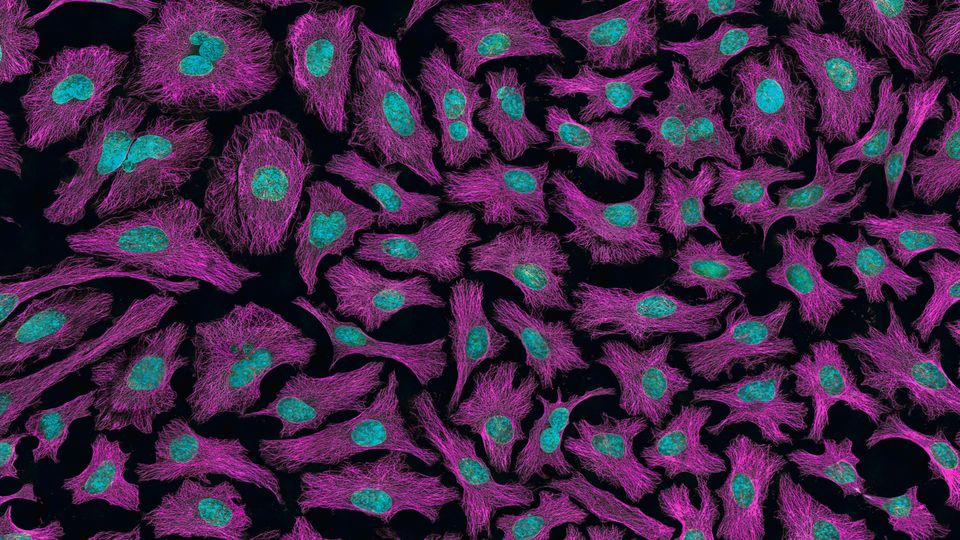
Researchers at the Nano Life Science Institute (WPI-NanoLSI), Kanazawa University, report in ACS Applied Nano Materials a new method to precisely measure nuclear elasticity—the stiffness or softness of the cell nucleus—in living cells. By employing a technique called Nanoendoscopy-AFM (NE-AFM), which inserts a nanoneedle probe directly into cells, the team revealed how cancer cell nuclei stiffen or soften depending on chromatin structure and environmental conditions.
The findings provide fundamental insights into how the physical properties of cancer cell nuclei change during disease progression, highlighting their potential as biomarkers for diagnosis and treatment evaluation.
Changes in nuclear mechanics are a hallmark of cancer and can indicate malignant transformation. Traditionally, nuclear elasticity has been studied using atomic force microscopy (AFM) probes pressing on the cell membrane or by aspirating isolated nuclei. Both methods suffer from limitations: they are influenced by surrounding cellular structures or fail to capture intact nuclear states. The new NE-AFM method developed by Takehiko Ichikawa and colleagues at Kanazawa University overcomes these barriers by inserting a nanoneedle probe directly into living cells thousands of times without causing severe damage, allowing nanoscale mapping of nuclear elasticity.
The researchers found that human lung cancer cells (PC9) showed significantly increased nuclear elasticity under serum-free conditions. This stiffening correlated with increased trimethylation of histone H4 at lysine 20 (H4K20me3), a marker of chromatin compaction. Treatment with transforming growth factor beta (TGF-β), which induces epithelial–mesenchymal transition (EMT), caused nuclear softening and reduced H4K20me3 levels. The study shows that nuclear elasticity changes are driven primarily by chromatin compaction states, not by alterations in nuclear lamins. Brain-metastatic derivatives of PC9 cells (PC9-BrM) exhibited similar nuclear elasticity trends, suggesting that chromatin regulation of nuclear mechanics plays a role in their invasive behavior.
The team employed Nanoendoscopy-AFM, a technique combining atomic force microscopy with nanoneedle probes fabricated by electron beam deposition. The probes, only ~160 nm in diameter, were inserted repeatedly into living cells to record thousands of force–distance curves across nuclear surfaces. From these measurements, the researchers created three-dimensional elasticity maps of intact nuclei in human lung cancer cells. Unlike traditional AFM methods, NE-AFM distinguishes cell membrane elasticity from nuclear elasticity and avoids interference from cytoskeletal structures. Immunoblotting experiments were also performed to correlate elasticity changes with histone modifications and nuclear protein levels.
“Our work shows that nuclear elasticity is not just a physical property but a reflection of underlying chromatin states,” says Ichikawa. “With Nanoendoscopy-AFM, we now have a powerful tool to directly probe the nucleus of living cancer cells. This opens the door to new diagnostic approaches and to a better understanding of how mechanical forces shape cancer progression.”
The research demonstrates that nuclear elasticity can act as a measurable biomarker of cancer progression. The NE-AFM method provides an unprecedented ability to probe intact nuclear mechanics and could become a tool for early cancer diagnosis and prognosis, studying chromatin regulation during metastasis, and exploring the mechanics of other organelles such as mitochondria.
Reference: Ichikawa T, Kono Y, Kudo M, et al. Probing nanomechanics by direct indentation using nanoendoscopy-AFM reveals the nuclear elasticity transition in cancer cells. ACS Appl Nano Mater. 2025;8(42):20239-20249. doi: 10.1021/acsanm.5c03044
This article has been republished from the following materials. Note: material may have been edited for length and content. For further information, please contact the cited source. Our press release publishing policy can be accessed here.